Table of Contents
Your brain makes 35,000 decisions a day. The molecule driving most of them isn't doing what you think it is.
We've all heard it. Dopamine equals pleasure. Dopamine hits. Chase the dopamine. Hack your dopamine.
It sounds good. It's catchy. And it's mostly wrong.
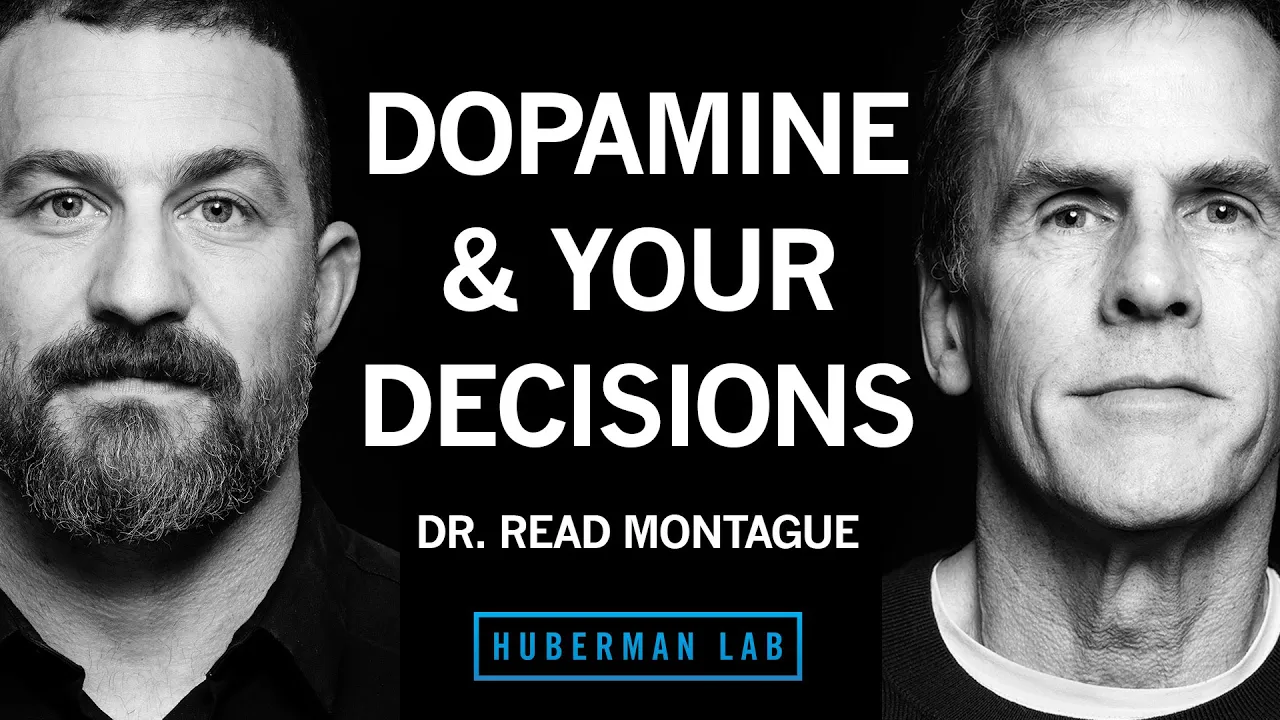
I recently listened to a conversation between Andrew Huberman and Dr. Read Montague — one of the world's leading experts on dopamine, the director of the Center for Human Neuroscience Research at Virginia Tech, and a pioneer in measuring dopamine in real-time in human brains. What he shared completely rewired the way I think about motivation, learning, and why we do what we do.
This isn't another "cold plunge your way to more dopamine" article. This goes deeper. And it has real implications for how you make decisions, build habits, and navigate everything from your career to your relationships.
Let's get into it.
Dopamine Isn't Your Reward. It's Your Teacher.
Here's the first mind-shift.
Dopamine is not primarily about feeling good. It's a learning signal.
Yes, dopamine fluctuates when something unexpectedly good happens. That part is true. But that's not even the most interesting thing it does.
Dr. Montague's research — spanning over 30 years — shows that dopamine's core job is to help you learn from the gap between what you expected and what actually happened. Neuroscientists call this a "reward prediction error."
But here's where it gets really interesting. Most of life doesn't look like expectation → outcome. Most of life looks like this:
Expectation → updated expectation → another updated expectation → maybe an outcome... eventually.
Think about it. You're working on a project at work. You don't get feedback every hour. You might work for weeks before knowing if it paid off. You're dating someone new. You don't know if it's going to work out on date two. You're collecting data — a text here, a conversation there, a friend's offhand comment — and your brain is constantly updating its predictions.
Dopamine encodes those moment-to-moment shifts in expectation. Not just the final win or loss. The entire journey of updating what you think is going to happen next.
This is called temporal difference learning. And it's not just neuroscience theory — it's the exact same algorithm that DeepMind used to build AlphaGo, the AI that beat the world champion at Go. The same algorithm that powered AlphaFold to solve the protein folding problem and win Nobel Prizes.
The algorithm running the most powerful AI systems on the planet? It was borrowed from your brain stem.
Let that sink in.
You're Always Foraging — Even When You Don't Realize It
Dr. Montague uses the word "foraging" to describe what we're doing most of the time. And I think it's the perfect metaphor.
Whether you're scrolling social media, evaluating a business opportunity, or figuring out if this new relationship is worth pursuing — you're foraging. You're moving from position to position, updating your expectations, and your dopamine system is tracking every shift.
Huberman shared a great example. A friend of his is on the dating market. She meets someone new and gets excited. Then a few days later, she learns something new about the person. Her expectations shift. Then she runs into one of their coworkers who shares a detail. Another shift. Then she goes on another date and... the whole picture updates again.
This sawtooth pattern of rising and falling expectations — that's dopamine at work. It's not waiting for the fairy tale ending. It's updating in real time, step by step, prediction by prediction.
And here's the crucial insight: dopamine doesn't just track these expectations — it drives your motivation based on them. When the updates are positive, you feel that pull forward. When they're negative, motivation drops. It's doing both jobs simultaneously — teaching you AND motivating you.
The Serotonin Plot Twist
Now here's something I'd never heard before, and honestly, it blew my mind.
Dopamine and serotonin operate as opponents. When dopamine goes up, serotonin goes down. When serotonin goes up, dopamine goes down.
Dr. Montague's team is one of the only groups in the world that measures both dopamine AND serotonin simultaneously in conscious human beings — at sub-second timescales. And the pattern is clear:
- Positive anticipation → Dopamine up, serotonin down
- Negative anticipation → Serotonin up, dopamine down
Think of it like a seesaw. Dopamine handles the "go chase that" signals. Serotonin handles the "wait, be cautious, something bad might happen" signals.
This makes intuitive sense. But the SSRI implication is where it gets wild.
The SSRI Problem Nobody Talks About
SSRIs — selective serotonin reuptake inhibitors — are among the most prescribed medications in the world. They block the reuptake of serotonin, so more serotonin hangs around in the brain. That's the intended mechanism.
But here's what Dr. Montague explains, citing a landmark 2005 paper from John Dani's lab at Penn, published in Neuron:
A large portion of that excess serotonin doesn't stay in serotonin terminals. It gets sucked into the dopamine terminals instead.
The dopamine transporter — the mechanism that normally cleans up dopamine — also binds to serotonin. Not as efficiently, but enough to matter. The study showed roughly a 40% difference.
So what happens? You now have the "negative juice" (serotonin) sitting inside the terminals that are supposed to fire for positive events. The downstream system receives what it interprets as negative information... during moments that should feel rewarding.
This could explain why some people on SSRIs experience:
- Emotional blunting — things that used to excite them just... don't
- Anhedonia — inability to feel pleasure
- Sexual side effects — reduced reward from physical intimacy
- Motivational flatness — everything feels "meh"
To be clear — SSRIs genuinely help many people. Dr. Montague acknowledges this. But the mechanism is far more complex than "more serotonin = less depression." And this particular finding deserves way more attention than it's gotten.
When Stress Flips the Script
Here's another finding that stopped me in my tracks.
Research from Mark Andermann at Harvard shows that when animals are in a starvation state, dopamine flips its role entirely. Instead of encoding positive prediction errors (learning about good things), it starts encoding aversive prediction errors (learning about threats).
Why? Because when you're in an emergency — when survival itself is the goal — chasing rewards is a luxury you can't afford. Your brain needs you focused on avoiding danger.
Dr. Montague extends this to humans. When someone has been through enough trauma, abuse, or chronic stress, their dopamine system can get stuck in this "emergency mode." Everything becomes about avoiding the next bad thing. Safety becomes the only reward. Moving toward anything positive feels dangerous.
As Montague put it: "Basic safety was reward. Everything else — you were in an emergency state."
This is why hurt people hurt people. This is why someone who's been through chronic adversity might have trouble trusting good things. Their dopamine system literally learned that the world is threatening, and it's going to take sustained safety — not just a few good days — to recalibrate.
The ADHD Brain: Explorer vs. Exploiter
One of my favourite parts of the conversation was the bee analogy.
Dr. Montague's colleague Brian Smith studies honeybees and has found that bees exist on a spectrum. On one end, you have the "ADD bees" — they feel the waggle dance, start heading toward the nectar source, and then get distracted. They explore. They find new things. On the other end, you have the focused bees — they fly straight to the nectar, grab it, bring it back. Pure execution.
Your brain has both of these modes inside it.
Sometimes you need to be the explorer — scanning for new information, new opportunities, new connections. Sometimes you need to be the exploiter — locking in, executing, following through on the plan.
The ratio between these modes? It's modulated by dopamine (and its invertebrate cousin, octopamine).
This reframes ADHD entirely. It's not a broken brain. It's a brain that's weighted toward exploration. And in certain contexts — combat, creative problem-solving, rapid decision-making — that's exactly what you need.
But in a world of infinite scrolling, where short-form content rewards constant context-switching... you might be training your explorer circuit at the expense of your exploiter circuit. You're building your ADHD muscle without even realizing it.
Effort Is the Secret Ingredient
Here's the practical takeaway that hit me hardest.
Huberman asked: Does effort strengthen learning? Dr. Montague's answer was nuanced — it might not be the effort itself, but the fact that effort slows you down. And slowing down gives your dopamine system time to do its job properly.
Think about it:
- Scrolling short-form video → No effort, rapid context switching, minimal learning retained
- Reading a book → Deliberate effort, slower pace, five to ten underlined insights per chapter
As Huberman put it: "It is exceedingly rare that a short clip provides information that really stays with me. Whereas when I read a book, it's exceedingly rare that I don't have five or ten things I go back to later."
The mechanism? When you move slowly and deliberately through information, your dopamine system has time to properly encode the expectation updates. The learning sticks.
When you scroll at the speed of your thumb, there's nothing for the algorithm to grab onto.
How to Actually Use This
So what do we do with all of this? Here are the practical frameworks:
1. Slow your foraging. Whether it's dating, career decisions, or learning a new skill — resist the urge to constantly context-switch. Give your dopamine system time to properly update expectations. Collect data slowly. Make deliberate moves.
2. Reframe "dopamine hits" as learning signals. When you feel that surge of excitement or that pang of disappointment — that's your brain teaching you something. Pay attention to what it's encoding. What expectation just got updated?
3. Protect your exploiter mode. If you're spending hours in exploration mode (scrolling, browsing, jumping between tasks), you're weakening your ability to lock in and execute. Build deliberate focus blocks into your day. Put your phone in another room — research shows even its presence in the same room lowers cognitive performance.
4. Earn your rewards through effort. The things that require effort and discomfort tend to encode deeper learning. This is why sports, challenging projects, and difficult conversations build you — the dopamine system needs the slow, effortful engagement to do its best work.
5. Monitor your stress levels. Chronic stress and hunger literally flip your dopamine system into survival mode. If you're running on empty — physically or emotionally — you're not going to code positive events as positive. Take care of the basics first.
6. Be cautious with simple narratives about neurochemistry. Dopamine isn't pleasure. Serotonin isn't just "the happy molecule." These are sophisticated, opponent learning systems that interact in ways we're only beginning to understand. Don't let a catchy headline simplify what's actually a beautiful, complex system.
The Bottom Line
Your dopamine system isn't a vending machine that dispenses pleasure when you insert the right coin.
It's the most sophisticated learning algorithm on the planet — the same one that powers the world's most advanced AI systems. It's constantly updating, constantly teaching, constantly pushing you forward.
The question isn't how to "hack" your dopamine.
The question is: What are you teaching it?
Every scroll, every shortcut, every time you choose the easy path over the effortful one — you're training the algorithm. Every time you sit with discomfort, slow down to think deeply, or resist the pull of instant gratification — you're training it too.
Ask yourself: If someone could see your dopamine trace for the last week — the full record of what you anticipated, what you pursued, what you learned from — would you be proud of the pattern?
That's the real wisdom here.
This article is based on insights from the Huberman Lab podcast episode featuring Dr. Read Montague, Director of the Center for Human Neuroscience Research at Virginia Tech.
Watch the full episode here -