Table of Contents
The most common thing in the world is sand. The most rare thing in the world is thought. AI transforms one into the other.
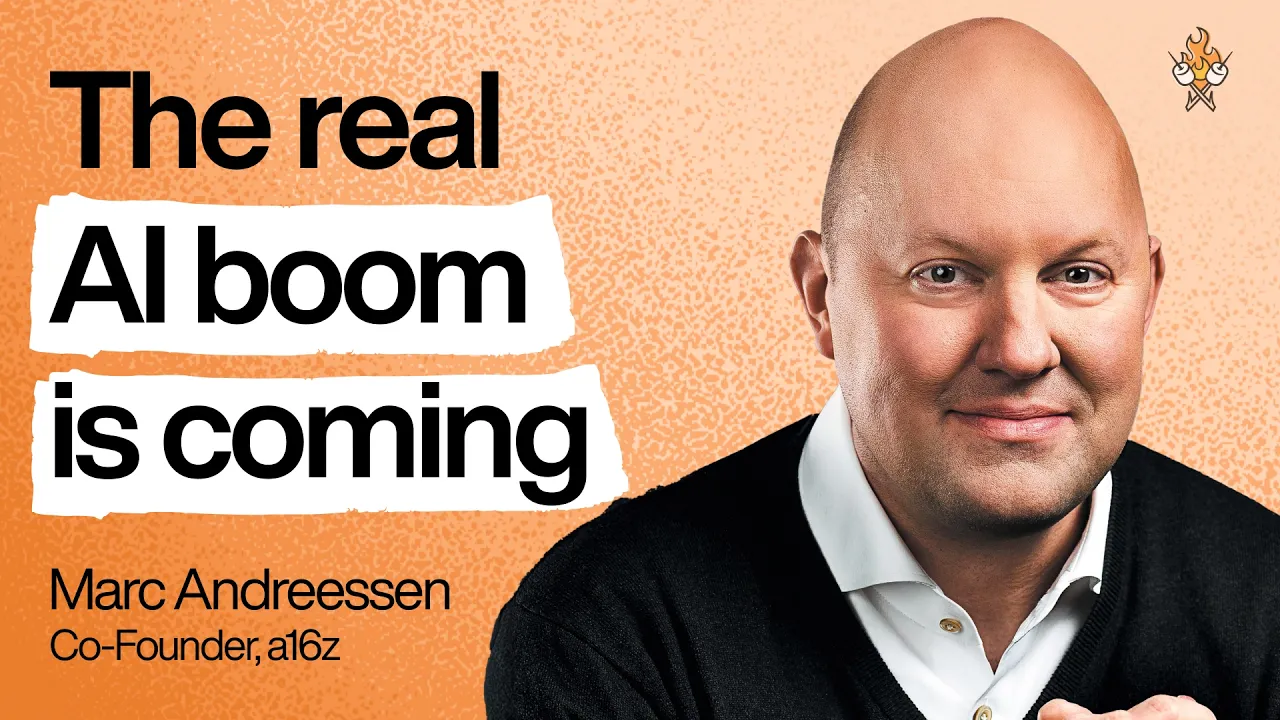
That's how Marc Andreessen—the man who invented the web browser, built Netscape, and co-founded A16Z—describes the moment we're living through.
I recently listened to his conversation with Lenny Rachitsky, and it fundamentally shifted how I think about AI, careers, and the future. Not because it was optimistic (though it was). But because it was grounded.
No hype. No doom. Just clear frameworks for understanding what's actually happening and how to position yourself to thrive.
Here are the seven frameworks that stood out.
1. The Philosopher's Stone Framework
Isaac Newton spent decades obsessed with alchemy—the quest to turn lead into gold. He never figured it out.
Now we have something more powerful.
AI transforms the most common thing in the world (sand, which becomes silicon chips) into the rarest thing in the world (thought).
This reframe matters because it shifts your mindset from "AI is taking jobs" to "I now have access to the philosopher's stone."
The question isn't whether you'll use it. The question is: how effectively will you wield it?
Newton would have traded everything for access to what you have on your phone right now.
2. The Superpowered Individual Framework
Here's what Andreessen observes about the best performers in every field right now:
AI takes people who are good at something and makes them very good.
But here's the kicker… it takes people who are very good and makes them spectacularly great.
The best coders aren't just twice as productive. They're 10x more productive. The gap between "pretty good" and "elite" is widening, not narrowing.
The practical implication:
Don't just use AI to do your current job slightly better. Use it to become spectacularly good at the intersection of multiple skills. That's where the real leverage lives.
3. The Mexican Standoff Framework
Andreessen describes what's happening between product managers, engineers, and designers as a three-way Mexican standoff:
- Every engineer now believes they can be a product manager and designer (because AI can help)
- Every product manager thinks they can code and design (because AI can help)
- Every designer knows they can do product and engineering (because AI can help)
Here's the twist: They're all correct.
The silos are dissolving. The winners won't be the purists who stay in their lane. The winners will be the ones who expand across lanes while maintaining depth in at least one.
Which brings us to...
4. The F-Shaped Skill Strategy
Forget the T-shaped professional. Andreessen (building on Scott Adams' insight) suggests something more powerful.
Scott Adams couldn't have created Dilbert by being the world's best cartoonist OR by being a business expert. He needed to be pretty good at both.
The additive effect of being good at two things isn't 2x. It's more like 3-4x. Being good at three things? Even more disproportionate.
Picture an F turned on its side:
- One vertical stroke of deep expertise
- Two or three horizontal strokes of complementary skills
An engineer who can also design AND understand product strategy? That's not fungible. That's invaluable.
Larry Summers put it differently: "Don't be fungible." Don't be a cog that can be swapped out. Be the person who uniquely combines skills that rarely exist together.
5. The Task vs. Job Framework
Everyone's worried about job loss. But Andreessen points out that economists don't actually think at the job level. They think at the task level.
A job is just a bundle of tasks.
Tasks change all the time. The job often persists.
Consider this example: In 1970, an executive never typed their own memos. They dictated to secretaries who typed them up. The secretary role still exists today—but the tasks have completely changed. Now they're planning travel, coordinating events, managing calendars.
The executive's tasks expanded too—they now do their own emails, which would have been unthinkable 50 years ago.
The implication: Don't worry about your job disappearing. Focus on which tasks within your job are changing, and make sure you're the person who masters the new tasks.
6. The Bloom Two Sigma Framework
Educators have spent decades trying to improve educational outcomes. Almost nothing works consistently—except one method that routinely raises student performance by two standard deviations.
One-on-one tutoring.
A student at the 50th percentile can reach the 98th percentile with dedicated tutoring. Every royal family, every aristocrat in history knew this. Alexander the Great was tutored by Aristotle.
The problem? It's never been economically feasible for normal people.
Until now.
AI is the great equalizer. For the first time in human history, everyone has access to infinite one-on-one tutoring. You can ask AI to teach you anything—and then quiz you, give you feedback, and help you actually learn.
But here's what most people are missing: they use AI to do work for them when they should also be using it to teach them.
Every hour you could be asking: "AI, train me up. Help me become better at this skill."
7. The Indeterminate Optimism Framework
Andreessen describes himself as an "indeterminate optimist."
The distinction comes from Peter Thiel's framework:
- Determinate optimism: "The world will be better because I will make it so" (Elon Musk building specific companies)
- Indeterminate optimism: "The world will be better because smart people will figure things out" (venture capital, Silicon Valley)
Thiel has historically criticized indeterminate optimism as wishful thinking.
But Andreessen offers a defense: the magic of the system is that we don't just have ONE determined optimist. We have thousands. Each running experiments. Each building something specific.
The lesson for you: Be a determinate optimist about your own life. Have a specific plan. Execute against it. But also trust that the broader system—thousands of smart people building things—will create opportunities you can't currently predict.
The Counter-Intuitive Case for Optimism
Here's what struck me most about Andreessen's worldview.
Everyone's worried about AI taking jobs. But flip the lens:
If we didn't have AI, we should be in a panic about demographic collapse.
Birth rates are falling globally. Many countries will literally depopulate over the next century. Without new technology, that means shrinking economies, fewer opportunities, and decline.
The timing is almost miraculous. We're getting AI and robots precisely when we need them—to maintain productivity as the human workforce shrinks.
The remaining human workers won't be at a discount. They'll be at a premium.
Your One Action
Andreessen's 10-year-old son is homeschooled. His primary educational tool? Talking to AI. Building things with Replit. Being quizzed, corrected, and taught—for hours—by language models.
That's the future of learning. And it's available to you right now.
This week, try this: Instead of just using AI to do work for you, ask it to teach you something. Pick a skill adjacent to your main expertise. Spend 30 minutes having AI train you like a personal tutor.
"Teach me the basics of [X]. Then quiz me to see if I understand."
The philosopher's stone is sitting in your pocket. The question is whether you'll use it to become spectacularly great—or let it gather dust.
You can watch the interview here -